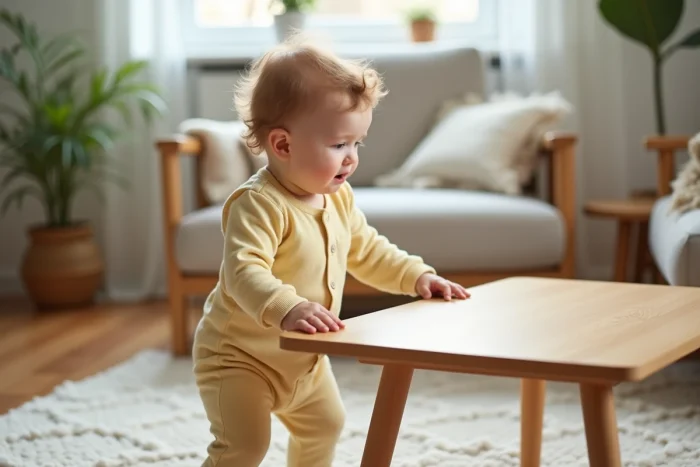
The acquisition of independent walking occurs within a broad developmental window. The WHO documents it between 8.2 and 17.6 months, representing nearly ten months of difference between the extremes of the norm. This variability reflects individual neuromotor maturation, not a cognitive deficit. Here, we analyze what recent longitudinal data reveal about the supposed link between late walking and intelligence.
Transitory correlations between early motor skills and cognitive scores
Longitudinal studies identify a statistical correlation between early motor acquisition and cognitive scores measured between 18 and 24 months. Babies who sit or move slightly before the median tend to score better on certain standardized tests during this window.
This result fuels confusion. It does not demonstrate that walking early makes one smarter, but that motor skills and cognition share common neural substrates during the first two years. Autonomous locomotion alters spatial exploration, enriches social interactions, and stimulates attentional circuits. This gain is measurable in the short term.
The point that popular articles consistently overlook: this advantage disappears before entering primary school. Cohorts followed beyond five years show no significant difference between early and late walkers on cognitive tests. The initial correlation is transitory, not predictive.
The relationship between late walking in babies and intelligence is therefore based on a statistical misunderstanding: confusing a temporary association with lasting causality.
Swiss longitudinal study: IQ measured at 7 and 16 years

The most robust study on the subject remains the Zurich cohort led by Oskar Jenni (Children’s Hospital Zurich) and Valentin Rousson (University of Lausanne), supported by the Swiss National Fund. It followed the development of 222 healthy children from a longitudinal cohort of 700 children born between 1978 and 1993.
The results are clear. At 7 years old, IQ is not associated with the age of first steps, after adjusting for socio-economic status and parental education level. Children who walked at 10 months show no measurable advantage compared to those who walked at 16 or 17 months.
This finding holds into adolescence. At 16 years old, neither academic performance nor IQ differed between the two groups. The researchers conclude that most parental concerns regarding delayed walking are unfounded, provided the child was born healthy and shows no associated neurological signs.
Why this study is decisive
The length of follow-up (up to 16 years) and adjustment for confounding variables (parental education, socio-economic background) distinguish these results from short-term cross-sectional studies. Most online content cites this research without mentioning the adolescent follow-up, which weakens the message’s impact.
Real factors influencing the age of walking in babies
If intelligence does not explain late walking, what does? We identify five documented factors:
- Body proportions and muscle tone: a baby with a long torso and short legs statistically takes longer to stabilize their bipedal posture. The weight-to-height ratio directly affects balance.
- Time spent on the ground: prolonged carrying practices, intensive use of bouncers or walkers reduce opportunities for free motor exploration. Time on the ground correlates with the precocity of walking.
- Temperament and risk tolerance: some babies prefer crawling, which is more efficient and safer, until they have acquired sufficient postural confidence. This choice is not a delay; it is a motor strategy.
- Family history: the genetic component of walking age is documented. A parent who walked late increases the likelihood that the child will follow a similar timeline.
- Cultural variations: child-rearing practices (massage of lower limbs, early postural exercises in certain African cultures, motor restrictions in other contexts) significantly alter the median age of walking within the same population.

When to consult a pediatrician for delayed walking
A baby who is not walking at 15 months remains within the statistical norm. The absence of independent walking at 18 months warrants a pediatric evaluation, not to measure intelligence, but to rule out specific neurological or orthopedic causes.
The signals that motivate an early consultation do not concern the age of walking in isolation:
- Persistent asymmetry in limb use (one side consistently favored)
- Marked trunk hypotonia after 12 months, with difficulty maintaining a seated position without support
- Motor regression: loss of previously acquired skills (no longer sitting when they could)
- Concurrent absence of varied babbling and communicative gestures (pointing, reaching out) after 12 months
The pediatrician then evaluates overall development, not just motor skills. An isolated delay in walking, without other associated signs, does not predict cognitive disorders or learning difficulties.
Distinction between simple delay and developmental disorder
A simple delay in walking concerns a child whose other acquisitions (language, social interaction, fine motor skills) progress normally. This profile represents the vast majority of consultations for late walking. A developmental disorder, on the other hand, involves multiple delays in different areas and requires specialized assessment.
Parents who are concerned about a link between late walking and intelligence can remember one simple fact: no rigorous longitudinal study has demonstrated that the age of first steps predicts IQ in the medium or long term. The variability in walking age reflects normal biological diversity, not a cognitive hierarchy.