
France and Japan occupy neighboring ranks in the global economies by nominal GDP. Both countries are among the top ten powers, with very different industrial, demographic, and energy profiles. Comparing their actual economic weight requires going beyond the simple GDP figure to examine the structure of their trade, their exposure to supply shocks, and their recent strategic choices.
Energy Dependence and the Strait of Hormuz Crisis: The Resilience Test
The nominal GDP ranking generally places Japan a few ranks ahead of France. Germany, which recently surpassed Japan in nominal GDP, further complicates the picture. However, these fixed hierarchies mask a decisive factor: the vulnerability of both economies to an energy supply shock.
The Strait of Hormuz concentrates a major share of global oil transit. Any disruption in this area directly affects net hydrocarbon-importing countries. Both France and Japan are net importers, but not in the same proportions or with the same margins of maneuver.
France derives a significant portion of its electricity from nuclear power, which reduces its dependence on imported gas for energy production. However, its crude oil imports remain largely directed towards the Middle East. A prolonged blockage of Hormuz would lead to a rapid increase in transportation and industrial production costs.
Field reports observed in Quebec since January 2026 illustrate this mechanism: the rise in energy costs related to the blockade has led to job losses in non-manufacturing sectors, well beyond just tariff impacts. This type of economic contagion would hit France hard, where a detailed analysis of the economy on Jean Le Cam puts these structural vulnerabilities into perspective.
Japan, historically very exposed to Middle Eastern imports, has been diversifying its supply sources for several years. Japan’s Indo-Pacific alliances are reshaping its energy security, with strengthened partnerships in Australia and Southeast Asia for liquefied natural gas.

Japan’s Indo-Pacific Alliances and Strategic Defense Pivot
On April 21, 2026, Japan lifted its ban on lethal weapon exports. This decision paved the way for a contract for 11 warships destined for Australia, the largest defense export contract ever signed by Tokyo.
This pivot is not solely military. The Japanese defense industry is becoming a full-fledged economic lever. Shipyards, electronic subcontractors, and embedded systems manufacturers benefit from massive orders that flow into the real economy. For a country with modest nominal growth, these flows represent a significant source of revenue.
France also has a strong exporting defense industry. In contrast, its strategic partnerships in the Indo-Pacific region are less structured than those of Japan with Australia, India, or ASEAN countries. Franco-Japanese cooperation exists, particularly on alternative LNG flows to the Gulf, with direct maritime charters from French terminals. However, this bilateral cooperation does not replace a dense network of regional alliances.
What Japan’s Economic Militarization Changes
The Japanese shift towards arms exports alters the balance in several ways:
- Defense revenues reduce Japan’s dependence on its automotive and electronics exports, two sectors weakened by Chinese and Korean competition.
- Military alliances strengthen trade agreements: Australia, Japan’s top defense client, is also a strategic supplier of minerals and LNG.
- The rise of the defense industry attracts R&D investments that benefit civilian sectors (robotics, artificial intelligence, composite materials).
France enjoys a similar advantage with its defense groups, but Japan concentrates its partnerships in a geographical area where the security of its supplies is at stake. This coherence between military strategy and economic strategy gives Japan a structural advantage that nominal GDP does not capture.
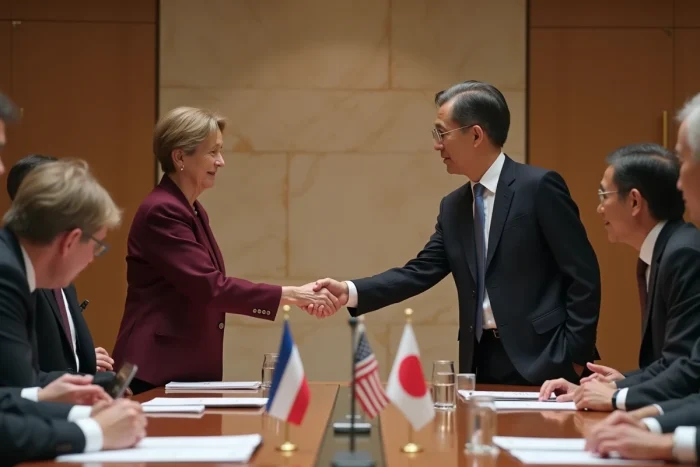
Nominal GDP vs. Economic Resilience: Two Readings of Power
Nominal GDP remains the most cited indicator for comparing economies. France and Japan compete for close positions, behind the United States, China, and Germany.
However, this indicator measures an annual flow of production. It says nothing about a country’s ability to absorb a prolonged external shock. Economic dominance is also measured by the ability to maintain activity in the event of a supply crisis.
On this criterion, the available data do not allow for a definitive conclusion. Japan has diversified its energy sources and consolidated its regional alliances, but its economy remains exposed to deflation and demographic aging. France has a solid nuclear base and an integrated European internal market, but its dependence on imported hydrocarbons and the rigidity of some of its productive sectors represent real vulnerabilities.
What Criteria to Differentiate France and Japan
Beyond GDP, several dimensions deserve examination:
- The diversification of trade and energy partners, where Japan has taken the lead through its Indo-Pacific agreements.
- The depth of the internal market, where France benefits from European integration and direct access to the single market.
- The capacity for industrial innovation, where both countries display complementary strengths (nuclear and aerospace for France, robotics and electronics for Japan).
- The demographic sustainability, a factor that weighs heavily against Japan in the medium term.
Neither country dominates the other across all these criteria. The answer to the initial question depends on the definition adopted for “economic dominance.” If we stick to nominal GDP, Japan retains a slight advantage. If we incorporate the geopolitical resilience of supplies, Japan scores points thanks to its Indo-Pacific alliances. If we weigh in demographics and access to the European market, France regains the advantage.
The ongoing Hormuz shock could reshuffle the cards. The coming quarters will reveal whether Japan’s strategy of energy and military diversification produces a lasting gap, or if France’s nuclear and European foundation absorbs the shock better than expected.