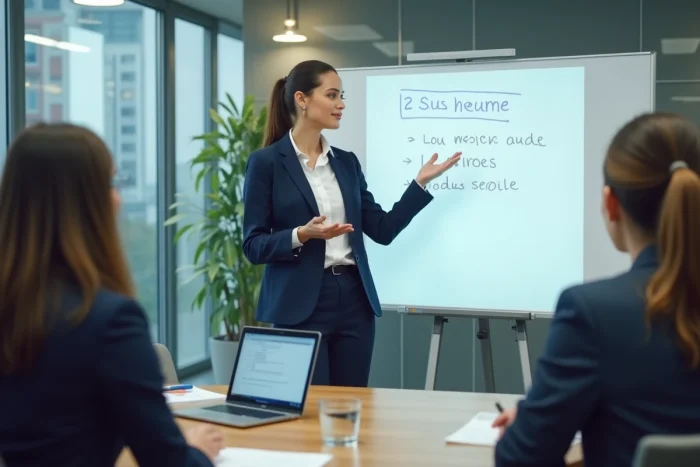
“Manageuse”: the word intrigues, disturbs, or asserts itself, depending on the ear that hears it. It slipped into administrative language in the early 2010s, but its entry into everyday practice remains hesitant, and the Académie française, true to a selective tradition, has yet to make a decision. However, in companies, the question is no longer just an academic debate. Between the habitual choice of the masculine and the conscious adoption of the feminine, the French language is moving forward cautiously.
On the ground, the logic varies from one sector to another. Some organizations show a marked preference for the masculine, regardless of who holds the position. Others, on the contrary, opt for the feminine without hesitation, even if it raises questions about the accuracy or legitimacy of these linguistic adaptations.
Why does the feminization of job titles like “manager” spark debate in French?
As soon as we touch on the feminization of titles related to management, the discussion heats up. Using the feminine form of manager is no longer trivial: the question divides opinions, shifts boundaries, and raises inquiries about the place of women in the workforce. In 2019, the Académie française recommended “manageuse,” following the General Commission for Terminology and Neology, which has been in favor of this choice since 2000. “Manager” and “manageuse” are now included in the Larousse dictionary, but the reality remains mixed. From one department to another, from one company to another, practices differ: here, titles are systematically feminized, while there, the masculine is retained, even in teams led by women.
At its core, why so much resistance? The French language, shaped by centuries of masculine dominance, struggles to integrate the feminization of professions. But behind grammar, there is something else: the question of recognition. Feminizing a title makes visible professionals who are sometimes relegated to the background, but it also challenges habits and can provoke unexpected tensions. For some, using “manageuse” embodies the evolution of mindsets and the affirmation of equality in the workplace. For others, this word disrupts a balance or seems artificial.
Collective representations are not neutral: they condition how women managers are perceived, their authority, and their legitimacy. Behind the choice of the word, a question resonates: does language influence reality? When a society hesitates to use “manageuse,” it also reveals its contradictions and aspirations. The feminization of professions is not just a linguistic detail: it is a lever to shift boundaries, strengthen professional equality, and ultimately shape a new collective imagination. To explore these issues and better understand how to use the feminine form of manager, the page “Le féminin de manager et son usage correct en français – Acti Carrière” offers in-depth insights.
Between “manageuse” and other forms: current usages and linguistic recommendations
The word manageuse is starting to carve out a place in the professional landscape, supported by recommendations from the Académie française and the General Commission for Terminology and Neology. The Larousse dictionary has also recognized it, a sign that the word is becoming established in usage, even though the masculine “manager” remains very widespread, including for women holding these positions.
Overview of usages
Here’s how the feminization of the title of manager is manifesting today:
- Official organizations: they prefer “manageuse” to respect the logic of feminizing professions.
- Companies: some embrace feminization in their communications, while others stick to the masculine, citing neutrality or continuity.
- Individual practices: usage fluctuates according to sectors, corporate cultures, and individual sensitivity to the issue of professional equality.
Choosing the feminine in a title is not just a matter of language. Saying “manageuse” is about giving visibility to women in management and injecting meaning into professional representations. Through this word, and the accompanying debate, the desire to evolve usages is taking shape, further anchoring the notion of equality in the daily life of the workplace.

Impact of the feminization of the title of manager on the visibility and professional recognition of women
Using “manageuse” is not just a passing trend. This choice reflects a profound transformation in the recognition of women’s roles at work. Feminizing the title affirms skills and career paths that often remained invisible behind a default masculine term. This visibility, supported by the Copé-Zimmermann law and inclusion policies, is part of a dynamic that goes beyond mere grammar.
Gender stereotypes continue to hinder women’s access to leadership positions. This famous glass ceiling, as symbolic as it is real, is beginning to crack thanks to the valorization of female leadership. Leaders like Isabelle Kocher, Anne Rigail, or Julie Walbaum testify to this: their impact is measured as much by their results as by the way language names and makes them visible.
Several levers support this evolution:
- Soft skills: empathy, emotional intelligence, and a sense of collectivity are managerial skills highlighted by female career paths.
- Coaching and continuing education: these initiatives support skill development and self-assertion in decision-making spheres.
- Professional networks: these structures accelerate women’s progression to strategic positions by advocating for more inclusive management.
By feminizing titles, companies contribute to transforming their internal culture. Recognizing the strength of female leadership is not just about updating a lexicon: it is about opening new perspectives, redefining norms, and preparing the ground for a generation that may not even question the right word. Language sometimes precedes mindsets, and sometimes it catches up with them.