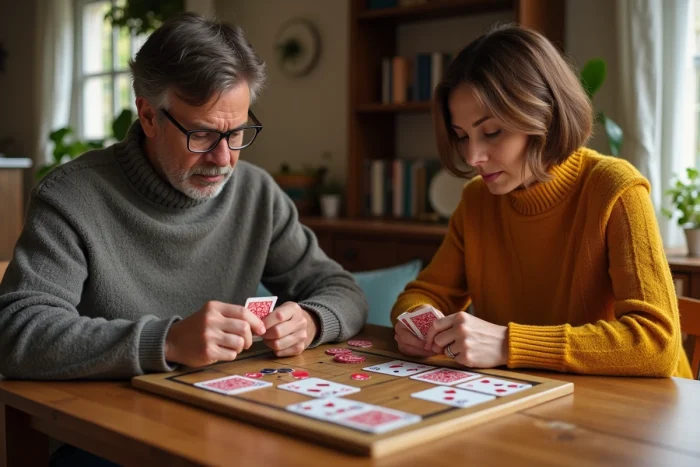
The removal of the central board and the redistribution of tokens radically changes the dynamics of Nain Jaune when played with two players. The oldest variant requires the removal of certain cards, while other versions maintain the full game but adjust the distribution of bets. Managing card counting remains a point of friction between proponents of classic rules and supporters of modernized approaches.
Some players bypass strict memorization to favor intuition, risking an imbalance in the games. These adjustments reveal the plasticity of a game whose rules constantly adapt to the constraints of the number of participants.
Nain Jaune: History, Spirit of the Game, and Reasons for Its Success
In France, in the 18th century, Nain Jaune established itself as an essential card game. Directly inspired by the tale written by Madame d’Aulnoy in 1698, it traverses literature to resurface in the collective imagination, even inspiring Pascal Jardin with his “Book Le Nain Jaune.” Depending on the region, it is also known as Lindor. This game captivates because it combines simplicity of mechanics, increasing tension, and constant calls for strategy.
The true pleasure of Nain Jaune lies in its conviviality: around the table, families and friends share games rhythmically punctuated by observation, anticipation, and demanding token management. This diversity of rules, including those adapted for two players like the Nain Jaune rule for 2 players and card counting, constantly renews the experience. The board, recognizable thanks to the famous Nain Jaune diamond, structures each game and multiplies the plot twists.
One only needs to observe the links between Nain Jaune and Rami, Ligretto, or Bataille Corse to understand its ability to transcend eras. It is not just a matter of nostalgia: it offers a unique balance between accessibility and depth. Three centuries of play have not diminished its popularity, proving its ability to evolve and adapt without ever growing weary.
What Are the Rules of Nain Jaune for 2 Players and the Main Variants?
When playing Nain Jaune with two players, the dynamics change. The board retains its five iconic spaces: 7 of diamonds (the famous “Nain Jaune”), 10 of diamonds, jack of clubs, queen of spades, and king of hearts. Here’s how the game is structured in this configuration:
- Each player receives an equal number of cards, until the deck is exhausted.
- The objective remains unchanged: to get rid of all one’s cards and collect the tokens associated with the special spaces.
- Each space on the board puts a key card into play, adding extra pressure to each round.
In a duo, each move carries more weight. The slightest card played becomes a risk or an opportunity. When a king ends a sequence, the player can open a new one, regardless of the color. If the round ends with a card in hand that corresponds to a space on the board, the penalty is imposed: the bet on that space doubles for the concerned player in the next turn. The tension is immediate: play is tight, every card counts.
Some adopt the variant known as “Grand Opéra,” where managing to get rid of all one’s cards in the first round allows one to collect all the tokens on the board. Other rules, depending on the region, replace the 7 of diamonds with the jack of diamonds as the central figure, thus altering strategies and the pace of the game.
Here are the specifics to remember for these variants:
- The game is fully dealt between the two players, with no deck left aside.
- At the end of each round, the penalty for a special card kept in hand structures the management of tokens.
- The alternation of sequences forces players to anticipate, closely monitor the opponent’s discard, and adjust their own tactics.
In a duo, Nain Jaune requires careful reading of the other player’s game and rigorous management of special cards. Each region, each family offers its own version, proof of the vitality and richness of this classic.

Counting Cards in Nain Jaune: Tips and Advice to Improve Your Games
In the arena of Nain Jaune for two, each card placed on the table becomes a piece of the puzzle. Observation is key: watch the figures already played, remember those that are missing, analyze your opponent’s choices each turn. Card counting builds up round by round: it is a discreet discipline that, without appearing so, offers a clear advantage in the pace of sequences and the management of special cards.
Here are some guidelines to refine your strategy:
- Identify early on the 7s, 10s, jacks, queens, and kings that have been played or are still in hand. With two players, each absence or appearance influences the flow of the game and your choices.
- Consider the order of values: when color no longer matters, a break in the sequence (a missing king or 10) can block everything. Keep these interruptions in mind.
- Pay attention to token management: finishing a round with a special card in hand means doubling the bet on the corresponding space. Adjust your tempo to avoid these penalties and observe if the opponent lingers on a key figure.
Building a winning strategy relies on memory and deduction. Counting cards also involves studying the other’s habits: do they prefer to keep their high cards to trap, or do they chain quick series? Every detail counts. Observing the cards already played allows you to anticipate the end of series or the impossibility of opening a new sequence: this is often where victory is decided.
Ultimately, Nain Jaune for two is a duel of observation and nerves. Between memory, intuition, and adaptation, each game tells a different story. There’s nothing stopping you from reinventing the rules to write the next chapter.