
You are preparing for a trip and your suitcase still doesn’t have a tag. The one provided by the airline has long since disappeared, and the models sold in stores don’t convince you. A downloadable PDF file, printed on thick paper and cut out in two minutes, solves the problem before you even close your bag.
Personal data on a luggage tag: what you are really exposing
Have you ever looked at the tag hanging from a neighbor’s suitcase on the conveyor belt? First name, last name, full postal address, phone number. Sometimes even an email address. These details are enough to locate an empty home while you are on vacation.
On an international flight, your luggage passes through several sorting areas, often accessible to temporary or subcontracted staff. A tag that is too talkative becomes an identity card readable by anyone.
To limit this risk without making the tag useless, a few simple choices make a difference:
- Only indicate a first name and the initial of the last name, rather than the full civil status.
- Replace the home address with a work address or that of your destination (hotel, place of stay).
- Prefer a mobile phone number rather than a landline, which reveals your geographical area.
- Add an email address created for the trip, different from your main inbox.
A well-designed minimalist template naturally guides you towards these choices. It includes the right fields, without unnecessary boxes for the postal code or country of residence. If you are looking for a free printable luggage tag PDF with this logic, the time savings are twofold: less data to fill out, less risk to manage.
Paper, weight, and cutting: making a tag that withstands travel
A PDF downloaded on standard office paper (the classic format of your printer) will not withstand a journey in the hold. The paper softens when in contact with moisture, the ink smudges, and the tag tears at the first friction against another bag.
Choosing sufficiently dense paper
A sufficiently dense weight is the first criterion for longevity. Cardstock sold in stationery stores, often in colored reams, works well. It passes through most inkjet and laser printers without jamming.
If you don’t have thick paper on hand, there is a quick solution. Print on regular paper, then stick the sheet onto a piece of recycled cardboard (cereal box, back of a notepad). The result is rigid and sturdy.
Laminating or protecting without equipment
Wide clear tape protects the tag as well as a laminator. Cover both sides before cutting the edges. The ink won’t run, and the paper will withstand rain on the tarmac.
For attachment, avoid simply punching a hole in the corner. A metal eyelet (available at craft stores) reinforces the attachment point. If not, fold the tag in half around the handle and secure it with tape. This method prevents tearing during automatic sorting.
Designing a PDF template that is readable at a glance
The readability of a luggage tag relies on three parameters: font size, contrast, and information hierarchy. A minimalist template is not an empty template; it is a structured template.
The name should occupy at least one-third of the visible surface. Below that, the phone number. In smaller text, the email address. Nothing else on the main side.
Secondary information (flight number, destination, dates) can appear on the back. In case of loss, the airline already has this data through the tracking system. Their presence on the tag is useful, but not a priority.
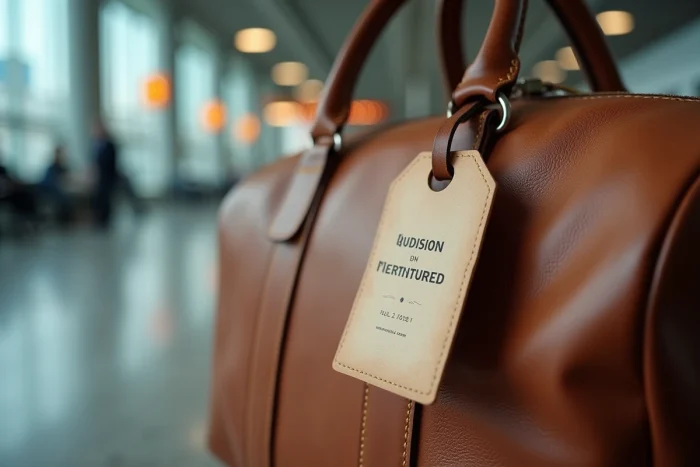
In terms of font, sans-serif fonts (like Arial, Helvetica) are easier to read from a distance and after lamination. Black text on a white background remains the most reliable contrast, even under artificial lighting in the hold or terminal.
QR code and digital tracking: a complement, not a replacement
Some travelers add a QR code to their tag. This code links to a webpage containing contact details, without displaying them plainly. The idea is good for privacy, but it has a concrete limit: a ground agent who finds a lost bag doesn’t always think to scan a code.
According to a report published by SITA in 2025, travelers using scannable QR tags linked to tracking apps see a significant reduction in lost luggage, up to 30%. Digital tracking complements the paper tag; it does not replace it.
The printed tag remains the last resort when technology fails. A legible name, a phone number, paper that withstands: these three elements have proven their worth long before RFID chips.
IATA also announced in 2025 a rising trend in tags incorporating RFID chips for real-time tracking, adopted by an increasing number of European airlines. This technology facilitates automated sorting, but it concerns tags issued by the airline, not those you make at home.
For an organized trip, combine a minimalist paper tag with a QR code linking to a temporary contact page. The paper ensures immediate readability, while the digital code offers a layer of protection for personal data. Together, they cover nearly all scenarios of lost or delayed luggage.