
The spring-summer 2026 fashion shows have set a precise stylistic framework, but the French regulatory context is changing the way these fashion trends reach stores and wardrobes. Since September 1, 2026, a financial penalty has been imposed on textile products deemed ultra-ephemeral under the extended producer responsibility. This mechanism changes the game for brands that relied on disposable collections renewed every two weeks.
Textile REP penalty and fashion trends: what the law changes this season
The anti-fast fashion system adopted in France imposes an additional cost on each product, adjusted according to the category. For certain coats and jackets, the penalty can reach up to 12 euros per piece in 2026-2027. The penalty is capped at half the retail price excluding taxes, making very inexpensive items particularly vulnerable.
The direct consequence affects trends based on ultra-frequent drops. When a low-priced jacket is burdened with a penalty that represents a significant portion of its production cost, the margin disappears. Brands targeting the French market are mechanically redirecting their collections towards longer-lasting pieces.
Starting January 1, 2027, advertising for products related to ultra-express fashion will be prohibited. In other words, promoting a fleeting trend will become legally impossible on French territory. This constraint is already pushing retailers to favor more enduring lines, with materials and cuts that survive a single season. The fashion trends of this season thus bear the mark of this transition, even if not all players are moving at the same pace.
To track the pieces that withstand this regulatory filtering, the Shop Mania fashion site lists updated selections that take these new market constraints into account.

Leather and sustainable materials: the dominant theme of the 2026 runways
Leather emerges as the common thread of the spring-summer 2026 collections. The shows have multiplied leather proposals in all its forms: short jackets, midi skirts, fitted trousers. This choice is not solely aesthetic.
In a context where sustainability is becoming an economic criterion (the REP penalty penalizes materials that do not last), leather offers a longevity argument that few synthetic textiles can claim. Brands positioned in the mid-range segment are incorporating more plant-based leather or recycled leather to meet the requirements of the European regulation on the eco-design of textiles, which is nearing finalization.
The European Union is indeed preparing a framework that will require clothing sold in its market to meet criteria for durability, reparability, and recyclability. Field reports vary on the exact timeline for implementation, but major retailers are already anticipating these obligations in their material choices.
Leather in a seasonal look: concrete associations
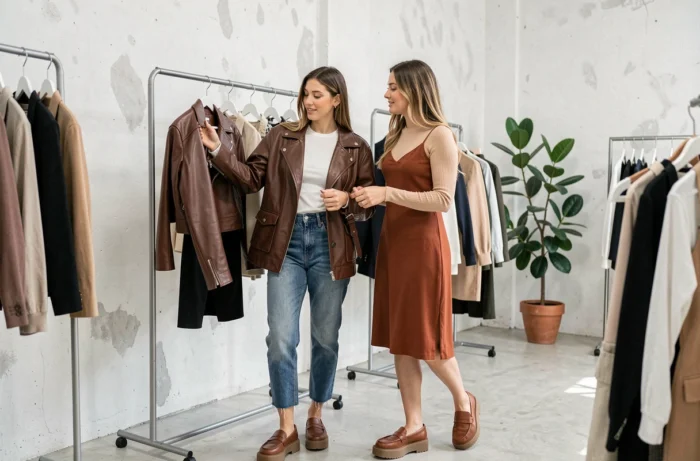
- A short leather jacket worn over a flowing linen dress lightens the silhouette while maintaining a visible structure, a balance very present on the runways this season.
- Soft leather pants, paired with a lightweight knit top, work well for both mid-season and summer evenings. Butter yellow or tobacco brown replace classic black.
- Leather accessories (wide belts, structured bags) allow for integrating the trend without investing in a statement piece, which suits budgets constrained by rising textile prices.
Pink, butter yellow, and white: the color palette of this season
The dominant colors of the season reflect a deliberate desire for softness. Pink, ranging from pastel to fuchsia, has been omnipresent on the runways. Several houses have built entirely monochromatic looks around this shade, from coats to shoes.
Butter yellow is establishing itself as the color to adopt for an effortlessly chic style. This warm yet subtle hue works on structured pieces (blazer, straight pants) as well as on fluid materials. It stands out from the bright yellow of previous seasons by having a lower saturation, making it wearable every day.
All-white looks are also making a comeback, worn in total looks. This minimalist approach aligns with the underlying trend towards reduced but versatile wardrobes. A well-tailored white ensemble can transcend several seasons without appearing dated, which aligns with regulatory incentives for sustainability.
Second-hand and circular fashion: a quarter of textile purchases in France
Second-hand is no longer a marginal segment. In France, second-hand fashion and ultra-fast fashion together represent about a quarter of textile purchases. This figure reflects a structural shift in the market, not just a simple niche.
Several brands are now integrating resale into their business model. The upcoming European regulation on textile waste is pushing manufacturers towards a circular logic, where each garment must be designed to be resold or recycled. The available data does not yet allow for measuring the precise impact of this obligation on retail prices, but the direction is clear.
For buyers, this evolution changes the way to approach the trends of the season. Adopting a trendy piece second-hand (a barrel jean, a leather jacket, an oversized blazer) allows one to follow the current style without suffering the cost increases related to the new production standards. Circular fashion is becoming a concrete lever to stay up to date.
Barrel jeans and loose cuts: the silhouette defining the 2026 style
The barrel cut of the jean, characterized by voluminous thighs and a tapered hem, dominates the denim offerings of the season. This silhouette breaks away from the skinny and straight cuts that have shared the market for several years.
The barrel jean alters the proportions of the entire silhouette, which necessitates rethinking the upper body. A fitted top or a bodysuit tucked into the high-waisted pants creates a contrast that structures the look. Conversely, a loose top worn over it erases the waist and produces an unflattering bulky effect.
Loose cuts are also found in fabric pants, bermudas, and long skirts. This trend towards volume aligns with post-pandemic comfort demands, but also with a logic of timeless pieces: a well-cut loose pant does not go out of style in three months, which protects it from the penalty reserved for ephemeral products.
The fashion market in France is undergoing a period where regulation, environmental awareness, and aesthetics converge towards the same choices. The fashion trends of this season are not just about colors or cuts: they bear the mark of a legal framework that redefines what a brand can produce and promote.
Investing in durable pieces, solid materials, and cuts that transcend seasons is no longer just a style choice; it is a response to a changing market.