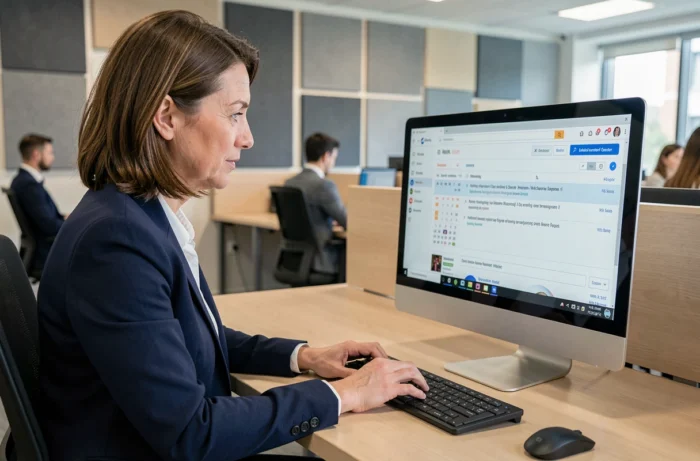
Zimbra CG66 brings together email, calendars and contacts for staff of the Pyrénées-Orientales Departmental Council. Behind this single interface, several settings determine how smoothly it works day to day. Which settings distinguish basic use from a truly productive setup on this platform?
Zimbra CG66 sync protocols: what the official documentation doesn’t always specify
General Zimbra guides describe IMAP, POP and ActiveSync as universal options. The actual settings (server addresses, ports and protocol restrictions) depend on the CD66’s own infrastructure. Copying settings from a third-party tutorial without checking with departmental support can lead to silent connection failures.
One often-overlooked issue is access from outside the departmental network. No public source confirms whether the CD66 webmail requires a VPN or applies IP address range filtering. Before configuring a mobile device or desktop application, the most reliable approach is to contact the Department’s network administrator directly.
To access Zimbra CG66 from a device outside the network, first confirm which access method is authorized; otherwise, the connection may be refused without a clear error message.
| Setting | General Zimbra documentation | What to expect on a departmental instance |
|---|---|---|
| Email protocol | IMAP / POP / ActiveSync | Protocols enabled according to local policy |
| Remote access | Webmail accessible from anywhere | VPN or IP filtering may apply |
| SMTP server | Port 587 / TLS | Confirm with CD66 support |
| Mobile sync | Native ActiveSync | May require prior approval |

Zimbra account security: authentication and caution with calendar invitations
Your password is the first line of defense, but it only covers part of the security picture. Multifactor authentication coverage varies by access method: webmail, mobile apps and desktop clients may not all offer the same level of protection. Check with your administrator which access methods actually enable a second factor to avoid a false sense of security.
A browser with a previous session stored in its cache may reject a login even when the password is valid. Clearing the browser’s cache and cookies, or using a private browsing window, resolves most of these issues.
Calendar invitations and associated risks
Zimbra vulnerabilities have previously affected the handling of embedded content in calendar invitations. An email calendar invitation may contain exploitable code if the instance is not up to date. Be cautious with any invitation from an unknown sender, even if it appears in the usual calendar interface.
- Do not automatically accept invitations from unidentified senders, even if they appear to be internal
- Report any invitation containing unusual attachments or links to external domains to support
- Check that the Department’s IT team applies Zimbra security updates regularly
Zimbra CG66 email: filters, folders and day-to-day email management
By default, Zimbra’s inbox displays messages in conversation view. This groups exchanges into threads, which works well for tracking long-running cases. For quickly processing incoming email, individual message view allows for more granular sorting.
Email filters are one of the most underused productivity tools. They can automatically route messages to specific folders based on the sender, subject or presence of keywords.
- Create a dedicated filter for automated notifications (system alerts, delivery receipts) to keep your main inbox clear
- Assign a folder to each project or department so you can find messages without always using search
- Use the flagging feature (star or flag) to distinguish emails that require action from those that are purely informational
- Schedule regular cleanups of the trash folder, because deleted items also count toward storage quotas

Zimbra shared calendar: access permissions and coordination between staff
Calendar sharing between colleagues uses a three-level permissions system: read-only, read and write, or full management. Granting a colleague “manager” access allows them to create, edit and delete events on your behalf. Each permission level determines what the recipient can see and do.
The granularity of these permissions can cause practical problems when several staff members share the same team calendar. A staff member with write access can move an appointment without notifying its original creator, unless change notifications are enabled in the calendar preferences.
Sharing with external users
Zimbra lets you share a calendar with people outside the organization using an ICS link. This link generates a read-only feed that can be viewed in most third-party calendar applications. Updates to the feed depend on how often the recipient’s client refreshes it, which can result in a delay of several hours between a change and its visibility to external users.
Calendar sharing is the module where configuration errors can have the greatest operational impact. An incorrectly assigned permission or a disabled notification can create a phantom appointment that no one sees, or that a staff member deletes without realizing it. Reviewing the effective permissions for each shared calendar once a quarter helps prevent this type of incident.