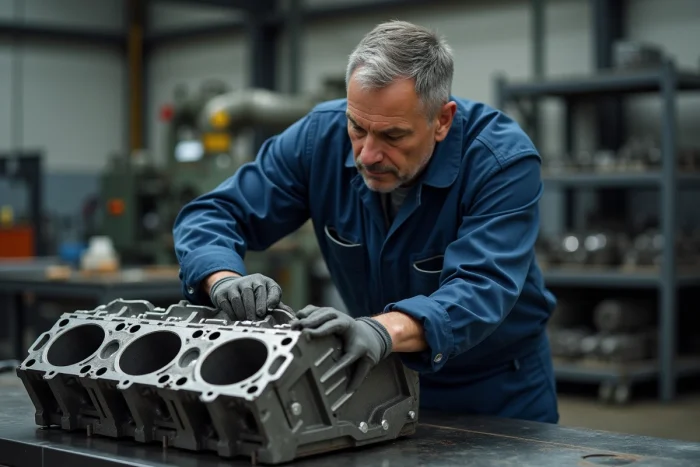
The forged engine block remains associated with the world of motorsport, but its use has been expanding in recent years to road preparations. The internal components (piston, connecting rod, crankshaft) made by forging rather than casting alter the mechanical behavior of the engine under heavy load. Understanding what happens at the metallurgical level allows us to gauge the real interest of this approach, its limits, and the constraints it imposes on the rest of the engine chain.
Crystalline structure and fiber orientation: what changes in forged metal
In traditional casting, the alloy (often an aluminum-silicon for pistons) is poured into a mold and then cooled. The solidification produces a relatively disordered granular structure, with micro-porosities trapped within the mass. These internal defects serve as potential crack initiation points when the part is subjected to repeated thermal and mechanical cycles.
Forging starts with a heated billet, which is then compressed under a press at several hundred bars. This compression aligns the metal fibers in the direction of the main stresses. The result is a denser part, with no internal porosity, whose fatigue resistance far exceeds that of a cast part of the same geometry.
A often underestimated point: this compaction also allows for a reduction in the thickness of the piston walls or connecting rod without losing strength. The forged part is therefore lighter at equal strength, which reduces the moving masses in the engine block. Less inertia means quicker revs and less strain on the crankshaft.
Understanding the operation of a forged engine block helps to comprehend why this technology is not just about a simple gain in strength.
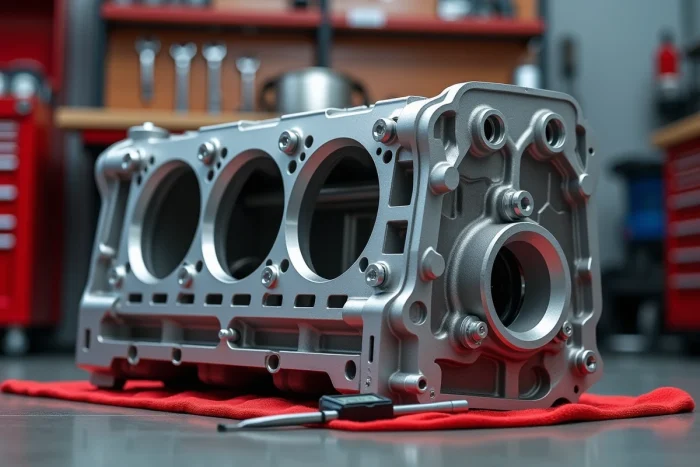
Recent alloys for forged pistons and connecting rods: the ‘street’ track versus the ‘race’ track
Since 2023, several performance equipment manufacturers have clearly distinguished two ranges of forged parts. The first, labeled “race,” prioritizes maximum resistance to high temperatures with significant piston/cylinder clearances. The second, called “street,” uses aluminum alloys optimized to reduce noise and vibrations (NVH approach) while maintaining mechanical strength suitable for road preparations.
The difference lies in the thermal expansion coefficient. A classic forged piston requires a larger cold clearance than a cast piston, which causes a characteristic knocking sound at startup until the engine reaches its operating temperature. Recent “street” alloys reduce this clearance thanks to a composition that limits expansion at low temperatures.
For a vehicle used daily, this detail changes the perception of the mechanics. A persistent cold knock can trigger an erroneous diagnosis during a shop visit or generate suspicion of engine problems at resale. Field feedback varies on this point: some preparers believe that NVH alloys sacrifice some ultimate strength, while others believe that the margin remains more than sufficient for mixed road/circuit use.
Forged engine block and anti-pollution standards: an underestimated constraint
Switching to a forged block often implies increasing the specific power of the engine, whether through raised turbo pressure, modified compression ratio, or recalibrated injection mapping. This power increase has direct consequences on pollutant emissions, a topic that has become critical since the tightening of technical inspection procedures in Europe.
OBD checks and pollution thresholds also apply to modified vehicles. An engine whose mapping has been revised to utilize forged connecting rods and pistons without adapting the pollution control system risks failing the technical inspection. Cold emissions, in particular, notably increase when the catalyst and lambda probe are no longer calibrated for the new operating regime.
Points to check before a forged preparation
- Does the original catalyst support the exhaust flow associated with the new power, or is it necessary to switch to a homologated sport catalyst?
- Does the injection mapping include a cold enrichment phase compatible with the vehicle’s OBD thresholds?
- Does the exhaust gas recirculation (EGR) system remain functional after the modification, or will a fault be recorded by the ECU?
These questions are not merely administrative details. A vehicle that fails the technical inspection for excessive emissions loses its ability to operate legally, regardless of the mechanical preparation level of the block.
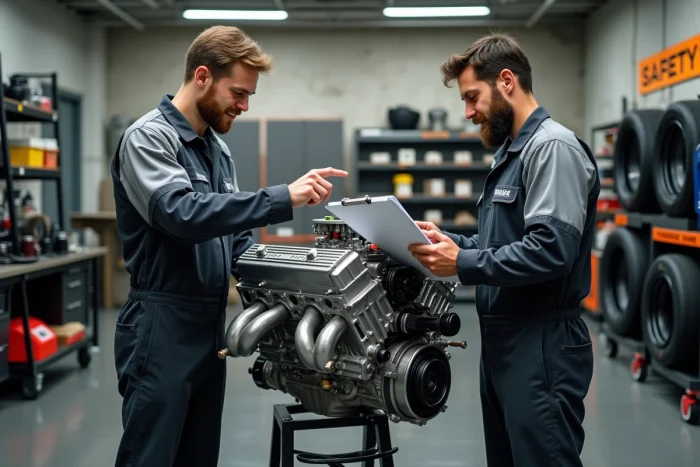
Mechanical resistance of the forged crankshaft under high turbo pressure
The crankshaft is the most stressed component in torsion in a prepared turbo engine. A standard cast crankshaft withstands the stresses anticipated by the manufacturer, but the margin disappears as soon as the boost pressure significantly increases. Preparers working on turbo blocks (notably TFSI engines at Audi or Renault Sport turbo blocks) replace the cast crankshaft with a forged treated steel crankshaft capable of absorbing torque spikes without permanent deformation.
The forged connecting rod plays a complementary role. Its superior rigidity transmits the combustion pressure to the crankshaft with less parasitic bending. The result is measured in long-term reliability rather than in raw power gain: a forged assembly does not produce more horsepower; it allows the engine to maintain the requested power without premature failure.
The available data does not allow for defining a universal turbo pressure threshold beyond which forging becomes essential. This threshold depends on the architecture of the block, the targeted maximum RPM, and the metallurgical quality of the original parts. In some recent engines, the stock components already offer a comfortable margin for moderate power gains.
The forged engine block is not a universal upgrade. It is a technical response to a specific level of mechanical stress, whose real interest depends on the vehicle’s intended use, the targeted turbo pressure, and the capacity of the rest of the chain (exhaust, pollution control, transmission) to keep up with the performance increase.