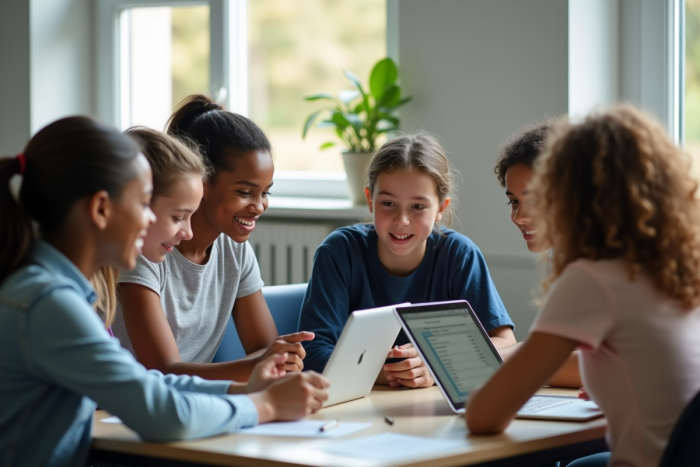
In 2023, more than 80% of French public colleges have at least one digital platform dedicated to learning. However, the gap is widening between institutions based on actual usage and the adaptability of teams. Some teachers report a persistent barrier related to training, while others are multiplying experiments.
The state invests every year in new devices, but the success of their integration largely depends on local ownership. Feedback from the field reveals discrepancies in perceptions regarding the effectiveness of the tools offered and their suitability for the daily needs of students and teachers.
Overview of digital resources transforming the classroom
Educational digital resources have never been as numerous or as crucial for renewing school life. They open the door to unprecedented forms of differentiation, support, and inclusion. Take Cantoo Exams: this platform allows students with specific needs to take their exams in a suitable environment, adhering to national standards, while adjusting to each individual’s profile through customizable accommodation tools.
The range of solutions goes well beyond all-digital. Here are some concrete initiatives deployed in institutions:
- “I create my teaching materials”: a program that invites the design of one’s own resources in fablabs, engaging teachers, students, and parents in a collective and creative process.
For learning French or mathematics, the focus is on fun and interactive methods. Corneille relies on a simple syllabic method; Lilote energizes reading through games; Archipel offers educational video games to help cycle 3 students review their basics without pressure. Specific needs also find responses: Dédys provides support for DYS students, while Story Play’R offers a catalog of enriched books with compensation tools, ensuring a pedagogical continuity that leaves no one behind.
Today, it is impossible to ignore the emergence of artificial intelligence: KartOOn, designed for cycle 2, is already engaging with it. And what about emotional support? Buddy, the companion robot, ensures inclusion and the well-being of students, a game-changer for many children. Each of these initiatives places personal data protection at the center of the game, under the active supervision of the national education and local authorities.
The experience Sogo in Lille illustrates how an academy can mobilize around digital tools designed to meet the challenges of inclusive education and personalized learning paths. But innovation never stops at tools: it disrupts habits, questions teacher training, and places the student at the heart of the educational system.

Innovative tools leading to concrete feedback: how academies are reinventing the educational experience
The digital academy is now part of the trajectory of the France 2030 plan. This initiative revolves around five major directions that structure the ongoing transformations:
- Establish personalized learning paths,
- Develop hybrid training,
- Embed digital technology at the heart of every institution,
- Support pedagogical continuity for all,
- Train staff in managing innovations.
The Lab’Innovation gives substance to this ambition. It offers teaching teams a space to test, share, refine new practices, and then disseminate them on a large scale. On the ground, the mobilization of teachers is tangible: the gradual adoption of digital work environments, the creation of shared resources, the integration of interactive modules—all of this shapes a renewed relationship between students and teachers.
Several initiatives structure this evolution:
- The Cned continues its experiments in hybrid and distance training, allowing for more flexible and individualized paths.
- Eifad supports continuous professional development, focusing on distance training.
- The PIA Digital Academy funds the design of innovative modules accessible to all members of the educational network.
At the same time, cooperation with local authorities firmly anchors projects in the territory. Even in challenging contexts, pedagogical continuity is organized. Feedback collected from the field highlights the adaptability of institutions and the skill enhancement of teams. Here, digital technology is no longer seen as a constraint: it becomes the tool that everyone appropriates, shapes, and adapts to best support each student.
In the face of these dynamics, the classroom has never been so lively and open: the academies that are inventing today are paving the way for the school of tomorrow, where every student can finally find their place and reveal their talents.