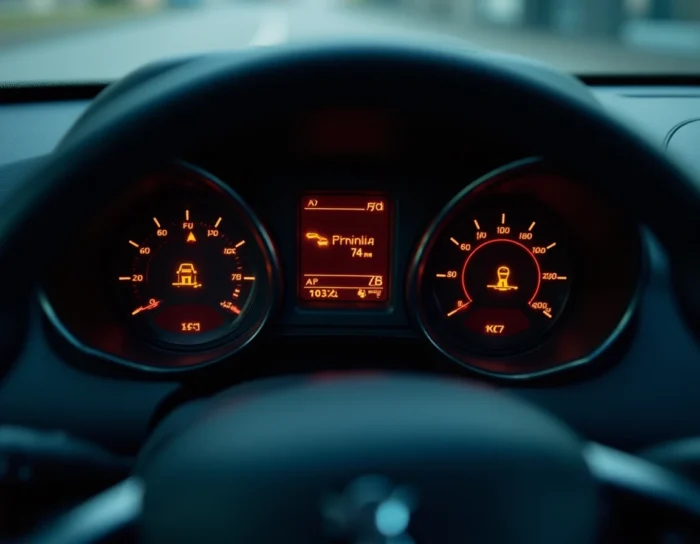
An icon lights up on the instrument cluster of your Peugeot 208, accompanied or not by an audible signal. Before looking for the exact symbol, the first reliable information is the color of the warning light. It determines whether you can continue your journey or if you need to turn off the engine in the following minutes.
Fixed or flashing warning light on Peugeot 208: an underestimated distinction
Most guides focus on the color of the warning lights. Red requires stopping, orange indicates a check, while green or blue signals an active function. This classification is correct but incomplete.
Have you ever noticed that the same orange light can either stay fixed or flash? On the 208, a fixed orange engine light indicates an emissions fault that needs to be diagnosed quickly. The same light, when flashing, indicates a risk of catalyst deterioration. The nuance changes the reaction to adopt: in the second case, immediately reduce engine speed and head to a workshop.
To find the explanations for the Peugeot 208 dashboard warning lights based on your engine type and model year, the official manual available via the Peugeot Service Box remains the most reliable reference.
The rhythm of the warning light also applies to red indicators. A flashing brake light may point to a low fluid level, while the same fixed light, combined with another indicator, may signal a failure in the ABS or ESP system. Always observe whether the light is fixed or flashing before deciding what to do.

Specific lights for the e-208: what changes compared to gasoline or Diesel
The same 208 model does not display the same indicators depending on its engine type. On the electric e-208 version, lights related to the charging cable, high-voltage system, and battery thermal management appear. These icons simply do not exist on a PureTech or BlueHDi 208.
Some of these lights may illuminate without a mechanical failure being the cause. Recall campaigns have affected e-208s for propulsion losses related to the battery or electric motor management software. The fixes applied by the Peugeot network included software updates and, in some cases, the replacement of electronic units.
If you buy a used e-208, checking the recall and update history with the Peugeot network can help avoid this type of problem. A persistent orange light on a recently acquired e-208 may indicate an uncompleted recall, not mechanical wear.
Engine light and wet timing belt on 208 PureTech
The orange engine light is the indicator that 208 owners encounter most often. On versions equipped with the 1.2 PureTech engine, this light may be linked to a well-identified problem: the degradation of the wet timing belt.
This belt is immersed in engine oil. Over time, fragments may detach and obstruct the lubrication circuit or cause engine desynchronization. The engine light then illuminates, sometimes accompanied by a loss of power or unusual vibrations.
Recognizing warning signs
Before the light illuminates, several signs may alert you:
- Black residues or visible particles during an oil change, indicating that the belt is beginning to degrade in the oil bath.
- A light knocking noise on cold start, which disappears after a few seconds once the oil is circulating.
- An abnormally high oil consumption between services, with no visible leaks under the vehicle.
Preventive replacement of this belt, according to the manufacturer’s recommendations or a specialized workshop, remains the best protection. Waiting for the engine light to come on may mean that internal damage is already occurring.

Red lights on Peugeot 208: reflexes that protect the engine
A red light requires a quick reaction, but not necessarily the same one depending on the indicator concerned. Confusing urgency with panic leads to poor decisions.
Oil pressure and engine temperature
The oil pressure light (symbol of a can) requires you to turn off the engine as soon as safety allows. Continuing to drive without sufficient oil pressure causes irreversible wear of internal parts within minutes. Check the level on the cold dipstick. If the level is correct and the light persists, the problem likely comes from the pump or the sensor: have the vehicle towed.
The temperature light works on the same principle. Turn off the engine, let it cool, then check the coolant level. Never reopen the circuit cap while the engine is hot.
Braking and battery
The red brake light may indicate a low brake fluid level or a handbrake still engaged. If the handbrake is fully released and the light remains on, have the braking system checked before resuming driving.
The battery light indicates that the alternator is no longer charging. The vehicle is running on battery reserve. You have a limited time before complete failure: turn off non-essential consumers (air conditioning, heated seats) and head to a garage.
Maintenance and diagnostics: when the dashboard is no longer enough
The dashboard lights provide an alert, not a diagnosis. An orange engine light can correspond to dozens of different fault codes, from a simple faulty oxygen sensor to a more costly injection problem.
Reading the codes via an OBD port (present on all 208s) allows for precise identification of the fault’s origin. Some consumer diagnostic tools read generic codes, but Peugeot manufacturer codes require a compatible PSA tool for reliable results.
- A light that comes on and then goes off upon restarting still deserves a diagnostic check: the fault is stored even if the indicator turns off.
- Clearing a fault code without fixing the cause will cause the light to return, sometimes within just a few kilometers.
- On recent 208s, some messages appear directly on the central screen with explicit text, in addition to the light on the cluster.
The dashboard of the 208 remains a reliable alert tool, provided you do not limit yourself to the color. Engine type, light rhythm, maintenance history: these three elements guide the correct reaction much more than a simple glance at the icon.